
Research
Research Program
My research seeks to understand how ecological and evolutionary processes shape the persistence of populations, the coexistence of species, and the resilience of ecosystems under environmental change. I combine theoretical models, statistical analyses, and empirical data from a wide range of systems to identify general principles that can guide conservation and management.
Although my work spans diverse taxa and ecosystems, it is unified by a common goal: developing predictive theory that helps explain why some populations and communities persist while others decline. By integrating ecological theory with real-world conservation challenges, I aim to build a research program that generates both fundamental insights and practical solutions.
Population Persistence in a Changing World
A primary focus of my research examines how populations respond to environmental change and multiple interacting threats. This research bridges theory and application by using conservation problems as opportunities to test general ideas about persistence, resilience, and extinction.
Much of my work has centered on endangered amphibians, where I have developed population models to evaluate extinction risk, forecast population trajectories, and assess restoration strategies. These studies integrate demographic uncertainty, environmental stochasticity, habitat dynamics, and management actions to inform conservation decisions.
More broadly, I am interested in understanding how populations respond to combinations of stressors that rarely occur in isolation. Climate change, habitat degradation, invasive species, and exploitation often interact in nonlinear ways, creating unexpected dynamics that can accelerate decline or impede recovery. My goal is to identify the ecological mechanisms that determine whether populations remain resilient or approach critical thresholds.
Representative publications
Brooks, G. C., Z. S. Feiner, A. Trudeau, and O. P. Jensen. 2026. Gradually, then suddenly: transient dynamics of collapsing fisheries in a warming climate. Ecological Modelling 522:111829. link
Chandler, H. C., G. C. Brooks, Y. Jiao, and C. A. Haas. 2026. Predicting long-term population viability for an imperiled salamander under future climate changes. Journal of Wildlife Management 90:e70158. link
Brooks, G. C., W. A. Hopkins, and H. K. Kindsvater. 2024. Concurrent threats and extinction risk in a long-lived, highly fecund vertebrate with parental care. Ecological Applications 34:e2946. link
Coexistence, Community Dynamics, and Biological Invasions
Species rarely exist in isolation. Instead, they persist within communities shaped by competition, environmental variability, disturbance, and dispersal. Understanding how these processes interact is one of the central challenges in ecology.
My research investigates the mechanisms that allow species to coexist despite sharing limited resources. Much of this work draws on coexistence theory, particularly the storage effect and other mechanisms that allow temporal environmental variation to promote biodiversity. I am particularly interested in how environmental change alters these mechanisms and reshapes ecological communities.
More recently, I have begun applying these ideas to biological invasions in freshwater ecosystems. Aquatic plant invasions provide a unique opportunity to study coexistence breakdown, community restructuring, and ecosystem management simultaneously. By combining spatial survey datasets with theoretical models, I seek to identify the processes that govern invasion success and determine when management interventions promote ecosystem recovery versus unintended ecological consequences.
Representative publications
Brooks, G. C., Z. S. Feiner, O. P. Jensen, and C. L. Hein. 2026. Ecological costs of invasive species management create narrow safe operating spaces for aquatic plant communities. Journal of Environmental Management 418:131012. link
Brooks, G. C., S. Goodman, W. Moore, H. C. Chandler, N. M. Caruso, J. A. Smith, T. A. Gorman, and C. A. Haas. 2025. Gopher Tortoise (Gopherus polyphemus) burrow associate communities are depauperate in modified landscapes. Community Ecology 26:223-237. link
Brooks, G. C., R. M. Moore, B. K. Rincon, T. A. Gorman, and C.A. Haas. 2025. Phenological differences of two sympatric ranid frogs in the southeastern United States. Ichthyology and Herpetology 113:335-344. link
Brooks, G. C., N. M. Caruso, H. C. Chandler, and C.A. Haas. 2023. Niche partitioning and the storage effect facilitate coexistence in an amphibian community. Ecology and Evolution 13:e10629. link

Applied Evolutionary Ecology
The diversity of living things is my preeminent fascination.
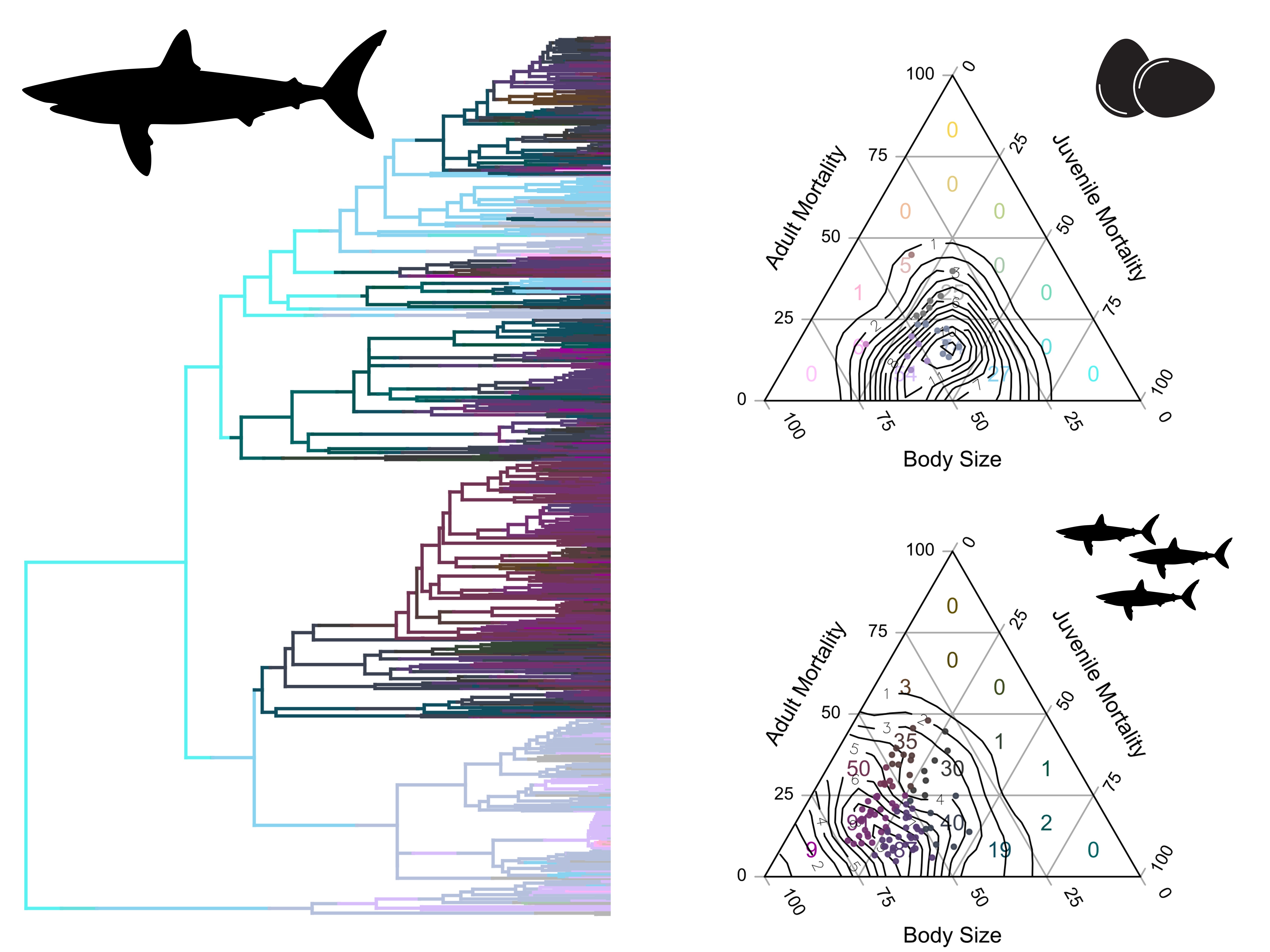
My research advances life-history theory to understand how tradeoffs shape biological diversity from local populations to major evolutionary transitions. This work combines comparative analyses, demographic theory, and evolutionary models to identify the constraints governing life-history evolution.
Further, by linking evolutionary history to contemporary population dynamics, I hope to provide a foundation for predicting how species may respond to future environmental change.
Representative publications
Brooks, G. C., Uyeda J. C., H. Conrad, N. Bone, C. Mull, and H. K. Kindsvater. 2025. Fundamental constraints on vertebrate life history are shaped by aquatic-terrestrial transitions and reproductive mode. Nature Ecology and Evolution 9:857-866. link
Brooks, G. C., H. C. Chandler, C. A. Haas, and H. K. Kindsvater. 2024. Ten principles from evolutionary ecology for the effective conservation of reptiles and amphibians. Journal of Herpetology 58:261-280. link
Brooks, G. C. and H. K. Kindsvater. 2022. Early development drives variation in amphibian vulnerability to global change. Frontiers in Ecology and Evolution 10:813414. link
Coupled Human-Natural Systems and Ecological Resilience
Increasingly, my research has expanded toward understanding social-ecological systems, particularly fisheries and other managed ecosystems.
Human behavior often drives ecological outcomes, while ecological change simultaneously influences human decision-making. These feedbacks can create unexpected dynamics that are difficult to predict using purely ecological or social models alone.
My work integrates ecological theory with social dynamics to examine how harvesting decisions, resource dependence, and environmental change influence the sustainability of fisheries and other renewable resources. By developing models that explicitly incorporate human behavior, I aim to improve predictions of ecosystem resilience and guide adaptive management in an increasingly uncertain world.
Representative publications
Castello, L., A. Abreu, G. C. Brooks, J. V. Campos-Silva, P. R. Cunha, A. Fleischmann, C. Franco, A. C. Gonçalves, E. Hultin, H. K. Kindsvater, E. Martins, C. I. B. Silva, M. G. Sorice, and E. S. Brondizio. 2026. Assessing social–ecological feedbacks in small-scale fisheries. Ambio 1-20. link
Brooks, G. C., E. A. Hultin, E. G. Martins, L. Castello, M. G. Sorice, and H. K. Kindsvater. 2026. Accounting for unreported harvest in fisheries with diverse social dynamics. Ecosphere 17:e70644. link
Brooks, G. C., Z. S. Feiner, A. Trudeau, and O. P. Jensen. 2026. Gradually, then suddenly: transient dynamics of collapsing fisheries in a warming climate. Ecological Modelling 522:111829. link